
By Frank Wenzel, RCIC (R709441), Wenzel Immigration Consulting Inc.
Let’s explore the road a registered nurse from Mexico or the United States has to take if she wants to come to Canada and get permanent residence (PR).
Let’s use British Columbia (BC) as an example. To work as a nurse you need a licence. To get a work permit, you need a job offer, but the licensing body, BCCNM, says it wants you to have permission to work in Canada before you apply. So which comes first, the chicken or the egg?
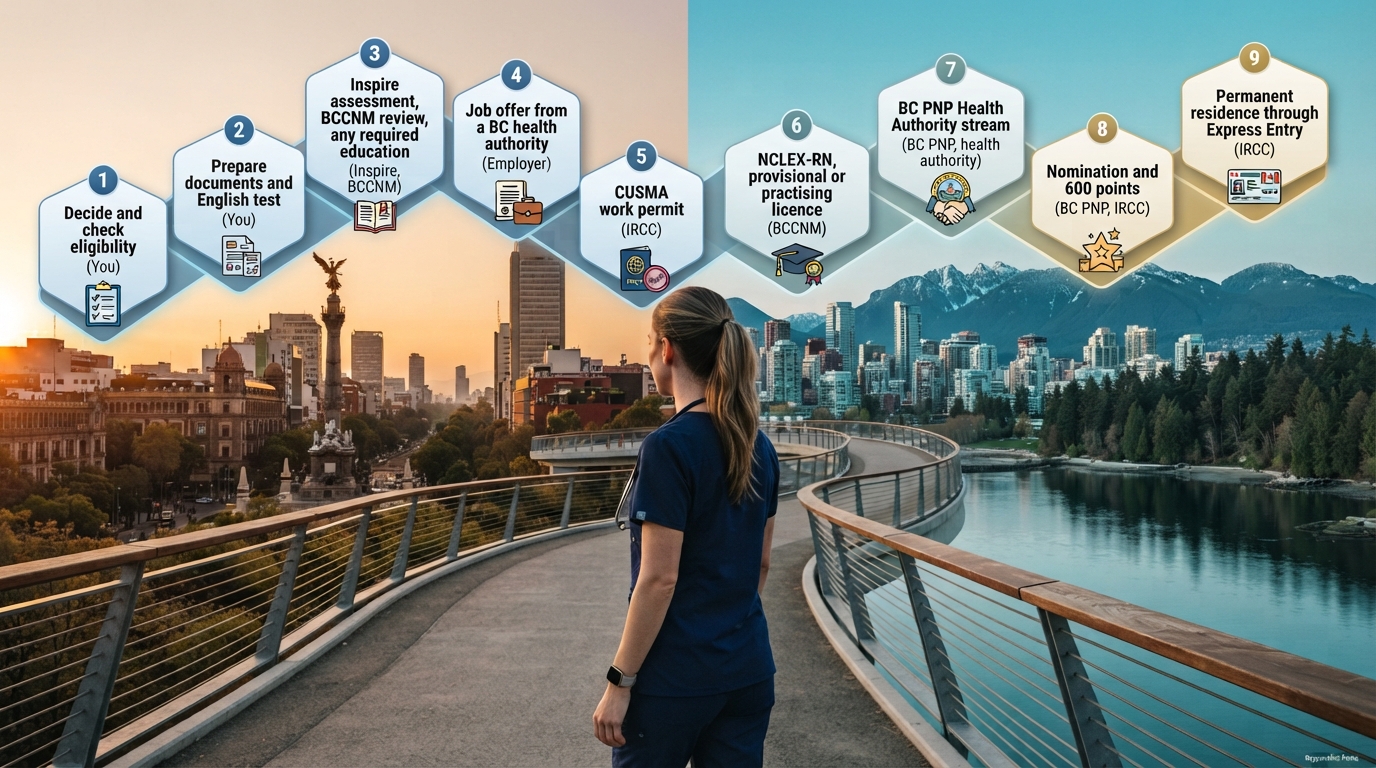
It’s a puzzle, and it stops a lot of good nurses before they start. In this article we untangle it and give you 9 steps, from nurse in Mexico or the US to permanent resident of Canada, in the right order, with official sources.
Let’s go.
First, three terms. CUSMA (T-MEC in Spanish) is the Canada-US-Mexico trade agreement, and it’s one of three free trade agreements Canada has with Mexico. BCCNM is the BC College of Nurses and Midwives, which licenses nurses. BC PNP is the BC Provincial Nominee Program, where BC picks workers it wants to keep.
Step 1: Is this realistic for you?
Check your education, your recent practice and your English before you spend money.
BCCNM says applicants are more likely to succeed if they finished nursing school or practised consistently within the last 10 years. Otherwise it may ask for a re-entry or bridging program first (BCCNM, internationally educated RNs, updated Nov. 24, 2026). For permanent residence you also need English at CLB 7, the Canadian language scale. The Federal Skilled Worker Program requires CLB 7 (IRCC, who can apply).
Step 2: How do you prepare and find reliable information?
Use official sources only: BCCNM, IRCC (canada.ca) and WelcomeBC. BCCNM says applicants must complete and submit their own applications and should not use agencies that charge to complete them. Gather your diploma, transcripts, cédula, work letters and passport. Inspire, the organization that assesses your education in Step 3, evaluates your education credentials. Check on its website whether it wants a credential evaluation from an outside agency before you pay for one.
Step 3: How do you get your BC nursing licence?
You deal with two organizations, and BCCNM lists the sequence:
- Apply to Inspire Global Assessments, which verifies your identity and assesses your English, education and nursing skills, then sends the results to BCCNM.
- Create a BCCNM account and apply for practising licensure. BCCNM recommends doing the Inspire and BCCNM steps at the same time.
- BCCNM reviews your education and practice and may require transitional education, from one course on the Canadian health system to a full bridging program.
- Once that’s done, BCCNM sends instructions to register for the NCLEX-RN exam. If you have met everything except the exam, you may be eligible for a provisional licence.
- After you pass, you can get a practising licence, but you can’t practise until you’re listed in the online directory.
A US nurse has a shorter road. If you were educated and are currently licensed as an RN in the US, BCCNM has a separate expedited pathway. BCCNM says US and Canadian jurisdictions use the same regulatory exam for RNs (BCCNM, applicants from the United States).
Here is where the chicken and egg shows up. BCCNM strongly recommends having the permits required to legally work in Canada before you apply. But the permit needs a job, and the job needs a licence.
The provisional licence is the piece that may help. It is optional, and BCCNM offers it once you have completed everything except the NCLEX-RN exam. You still can’t practise until you appear in BCCNM’s online directory. For BC graduates, BCCNM says a provisional licence lets you work as a nurse with conditions while you prepare for the exam (BCCNM, B.C. graduates). BCCNM’s page for internationally educated nurses doesn’t describe those conditions, so ask BCCNM exactly what a provisional licence lets you do, and ask early, because the date you qualify sets the timing of the steps after it. The official pages I checked also don’t say how IRCC treats a provisional licence when it assesses the CUSMA permit, so confirm that before you plan around it.
Most fees may be reimbursed through the Internationally Educated Nurse Bursary Program. You don’t have to join it to apply for registration, so read its terms, including any commitment to work in BC’s public health system, before you sign (BCCNM FAQ). BCCNM’s page gives no processing times. Plan for months.
Step 4: How do you find the job that makes everything else possible?
This step decides the path. The BC PNP Health Authority stream covers a regular, indeterminate, full-time job offer in an eligible health occupation from a BC public health authority (BC PNP Skills Immigration Program Guide, effective May 28, 2026). These are the regional and provincial bodies that run BC’s public hospitals and care services. A job at a private clinic or an agency won’t open this stream. Apply to their postings with your BCCNM status clearly stated on your resume.
Step 5: How do you apply for the CUSMA work permit?
Under CUSMA Appendix 2, “Registered Nurse” is a listed profession, and the requirement is a state or provincial licence or a licenciatura degree (CUSMA Chapter 16). A degree alone doesn’t let you practise in BC, though. To work as an RN you still need BCCNM’s licence. Canadian regulations let IRCC issue a work permit to a foreign national who intends to work under an agreement between Canada and another country’s government (IRPR s. 204). You apply with your job offer and your licence documents.
A CUSMA permit is one of the faster work permits. In my experience, once the file is complete, it can come through in a couple of days. If you’re a US citizen, you may be able to apply at the border. If you’re a Mexican citizen, you apply online from outside Canada (IRCC, changes for Mexican citizens). When IRCC approves it, you get a port of entry letter, and the border officer issues the permit when you arrive in Canada (IRCC, International Mobility Program). Bring the letter, your job offer and your licence documents. For the general CUSMA path, read my article How to Work in Canada in 2027 as a Mexican: The Fast Route Is CUSMA.
Step 6: How do you become a working RN in BC?
You pass the NCLEX-RN, BCCNM issues your practising licence and you appear in the directory. If you held a provisional licence, it updates to a practising licence once you pass. From that day you work as an RN with no conditions. That work is what you build the next steps on.
Step 7: How do you apply to the BC PNP as a nurse?
Registered nurse or nurse practitioner? Both can use this stream, in different ways.
- Registered nurse (RN): Registered nurses (NOC 31301) are on the BC PNP’s list of Health Authority-eligible occupations (WelcomeBC, BC PNP). You need a regular, indeterminate, full-time job offer as a direct employee of a BC public health authority.
- Nurse practitioner (NP): NPs who are not directly employed by a health authority may also be eligible. They must be licensed, or eligible to be licensed, as an NP in BC. BCCNM says internationally educated NPs must hold master’s-level education and establish eligibility for RN licensure (BCCNM, internationally educated NPs). That makes NP a longer road.
How you apply: you don’t register for this stream. You apply directly to the BC PNP. Your health authority must agree to support your application before you apply, and only people it has delegated can sign the Employer Declaration Form that goes with your file. Each health authority sets its own support process, and following it is your job. For the Express Entry BC option, you need a valid Express Entry profile number and a Job Seeker Validation Code. BC will not nominate anyone working in Canada without authorization.
Step 8: How do you get the 600 points?
Express Entry is the online system IRCC uses to select skilled workers for permanent residence. You create a profile, and IRCC scores it under the Comprehensive Ranking System, known as the CRS. The score is based on factors such as age, education, language skills and work experience. IRCC then holds regular rounds of invitations and invites the highest-scoring candidates to apply for permanent residence. A good profile can still wait a long time if other candidates score higher.
A provincial nomination changes that. When BC nominates you and you accept the nomination, IRCC adds 600 points to your score (IRCC, get or confirm a nomination). To see how large that is, the entire core section of the CRS (age, education, language and work experience) is worth at most 570 points for a single applicant (IRCC, CRS criteria). A nomination is worth more than all four of those factors combined, and the additional points section is capped at 600. You can receive these points only once, and they come from the nomination, not from your profile. The rule is written in the Express Entry Ministerial Instructions.
IRCC says the points will help you get invited, and that it might invite you. It does not describe them as a guarantee. IRCC does keep inviting candidates with a provincial nomination, through general rounds and rounds for nominees (IRCC, rounds of invitations). For a nurse, a nomination is the single strongest move in the whole process, and it is the reason Steps 4 and 7 matter so much.
Step 9: How do you apply for permanent residence?
You need a federal program. For the Federal Skilled Worker Program, you need at least one year of continuous full-time skilled work in the last ten years. With foreign education, you also need an Educational Credential Assessment. After the nomination, you receive an invitation and file your application online.
You may not even need the nomination. The healthcare and social services category needs 12 months of full-time work in one listed occupation within the past 3 years, in Canada or abroad. Registered nurses (NOC 31301) are on the list (IRCC, category-based selection). A category match does not guarantee an invitation.
A job offer can also add points. Since November 3, 2026, IRCC gives points for a qualifying job offer in a high-wage occupation, and it no longer requires an LMIA for that offer (IRCC, 2026 changes to Express Entry). Registered nurses are on IRCC’s high-wage list at the level worth 70 points. That is far less than the 600 for a nomination, but it helps if you are waiting on one. Check your score on IRCC’s page before you plan around any of this.
The nine steps at a glance
| # | Step | Who decides |
|---|---|---|
| 1 | Decide and check eligibility | You |
| 2 | Prepare documents and English test | You |
| 3 | Inspire assessment, BCCNM review, any required education | Inspire, BCCNM |
| 4 | Job offer from a BC health authority | Employer |
| 5 | CUSMA work permit | IRCC |
| 6 | NCLEX-RN, provisional or practising licence | BCCNM |
| 7 | BC PNP Health Authority stream | BC PNP, health authority |
| 8 | Nomination and 600 points | BC PNP, IRCC |
| 9 | Permanent residence through Express Entry | IRCC |
FAQ
Do I need a job offer before my BCCNM licence?
BCCNM does not list a job offer as a licensing step. The BC PNP stream does require one.
Can I apply to BCCNM from Mexico?
BCCNM’s page doesn’t say you must be in Canada, but it recommends having work permits first.
Is the nomination guaranteed?
No. The 600 points come only if BC nominates you.
Your next move
Back to that nurse in Mexico City. The chicken-and-egg problem is real, but it has an answer: licence, job offer, CUSMA permit, nomination, permanent residence. The hard part is making BCCNM, IRCC, a health authority and the BC PNP fit together on your timeline, because a date that doesn’t match between them can stall the whole chain.
I run a boutique practice, not a high-volume agency. I read every file myself, from the first form to the last letter.
Ready to map your own path? Book a consultation and bring your nursing documents.
Read in Spanish: De enfermera en México a residente permanente en BC: el camino en 9 pasos.
General information only, not legal advice for your situation. Rules change, so confirm on the official pages. / Información general, no es asesoría legal para tu caso. Las reglas cambian; confirma en las páginas oficiales.
Sources
- BCCNM, internationally educated RNs (updated Nov. 24, 2026)
- BCCNM, FAQ
- BCCNM, applicants from the United States
- BCCNM, B.C. graduates (provisional registration)
- BCCNM, internationally educated NPs
- BC PNP Skills Immigration Program Guide (effective May 28, 2026)
- WelcomeBC, BC Provincial Nominee Program (modified June 17, 2026)
- CUSMA Chapter 16, Appendix 2
- IRPR s. 204
- IRCC, changes for Mexican citizens
- IRCC, How to hire under the International Mobility Program
- IRCC, get or confirm a nomination (modified Mar. 24, 2026)
- Ministerial Instructions, Express Entry
- IRCC, Express Entry: CRS criteria (modified Nov. 3, 2026)
- IRCC, Express Entry rounds of invitations (modified Oct. 16, 2026)
- IRCC, category-based selection
- IRCC, 2026 changes to Express Entry (modified Nov. 18, 2026)
- IRCC, high-wage occupations (modified Nov. 23, 2026)
- IRCC, Express Entry: who can apply


Leave a Reply
Your email is safe with us.